
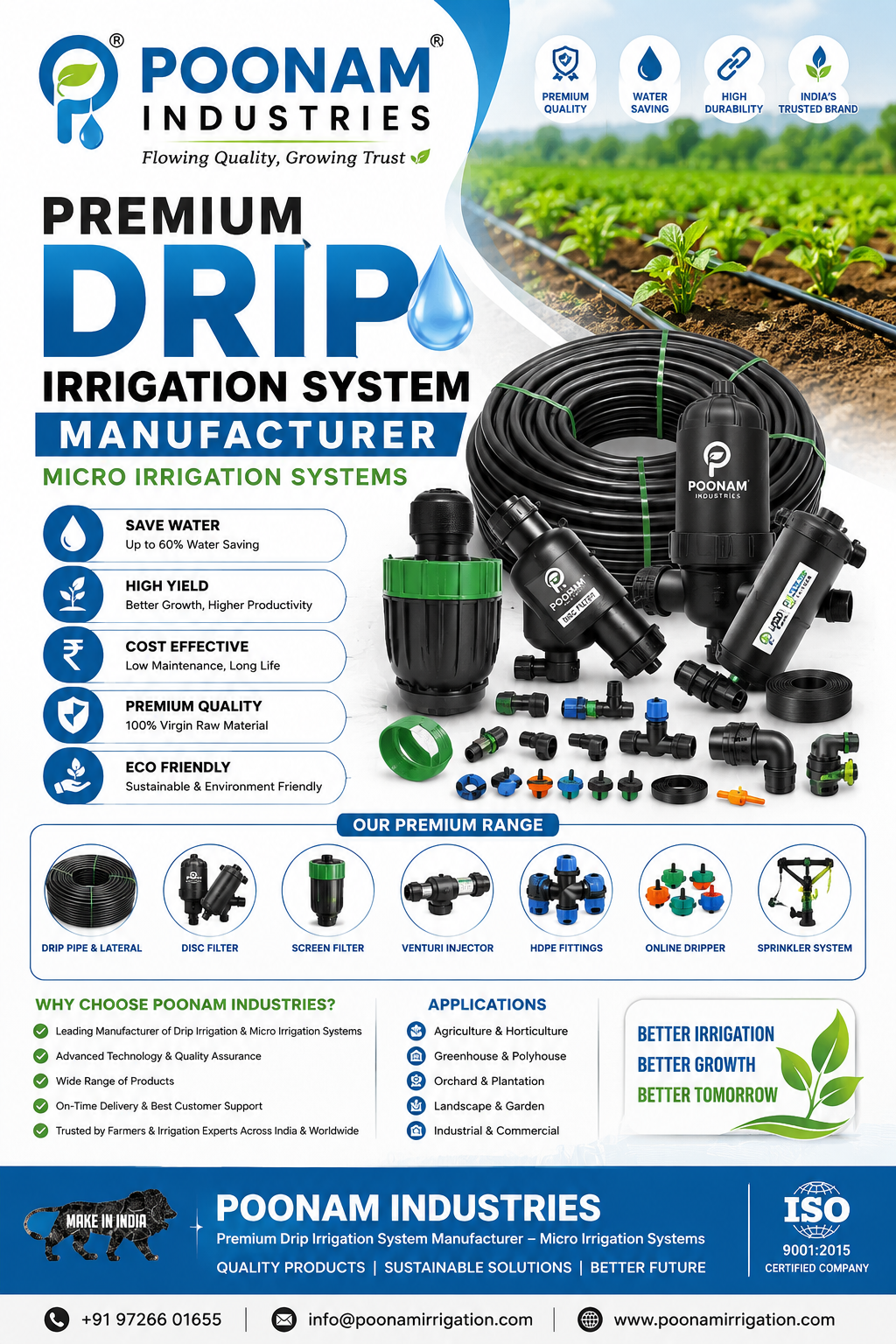
Discover premium Drip Irrigation Systems, Micro Irrigation Systems & Subsurface Drip Irrigation solutions. Poonam Industries is a trusted Manufacturer, Supplier & Exporter in India. Save up to 70% water with our precision irrigation systems, smart irrigation controllers, and high-quality drippers, filters, valves, and tubing. Ideal for agriculture, horticulture, vegetable farming, and orchards.


Drip Irrigation SystemA Drip Irrigation System delivers water directly to the root zone of plants through a network of tubing, emitters, and valves, ensuring maximum water efficiency with minimal wastage. Unlike traditional overhead sprinklers, drip irrigation reduces evaporation and runoff by up to 70%, making it ideal for water-scarce regions. This system promotes healthier plant growth by maintaining consistent soil moisture levels, reducing weed growth, and preventing foliage diseases. Perfect for row crops, orchards, vineyards, and greenhouses, a well-designed drip irrigation system ensures uniform water distribution, higher crop yields, and significant savings on water and fertilizer costs. It is the backbone of modern sustainable agriculture. | Micro Irrigation SystemA Micro Irrigation System is a precision watering method that applies water at low pressure and volume directly to the plant's root zone through drip emitters, micro-sprinklers, or sprayers. This highly efficient system minimizes water loss due to evaporation, runoff, and deep percolation, making it an essential tool for sustainable farming. Micro irrigation is particularly beneficial for high-value crops like vegetables, fruits, flowers, and plantation crops. It allows for precise application of water and nutrients, improving plant health and maximizing yield per unit of water. By adopting a micro irrigation system, farmers can combat water scarcity, reduce labor costs, and achieve consistent crop quality even in arid and semi-arid climates. | Subsurface Drip IrrigationSubsurface Drip Irrigation (SDI) is an advanced farming technique where drip tubing is buried beneath the soil surface, delivering water directly to the plant's root zone below ground. This method drastically reduces surface evaporation and eliminates water loss from wind runoff, making it one of the most water-efficient irrigation systems available. SDI promotes deeper root development, reduces weed germination, and prevents soil crusting, ensuring optimal crop health. It is widely used for field crops, sugarcane, cotton, and permanent horticulture. By delivering water precisely where it is needed, subsurface drip irrigation improves nutrient uptake, reduces fungal diseases on foliage, and significantly boosts overall farm productivity in water-limited environments. |
Drip Irrigation TubingDrip Irrigation Tubing is the primary conduit for transporting water from the source to the plant's root zone. Manufactured from high-quality HDPE, LLDPE, or PVC materials, this tubing is durable, flexible, and UV-resistant, ensuring long-lasting performance in harsh agricultural conditions. Available in various diameters and wall thicknesses, drip irrigation tubing can handle different flow rates and pressure requirements. It is designed to resist clogging, chemical degradation, and abrasion, making it ideal for both surface and subsurface applications. With precision-drilled holes or labyrinth drippers, the tubing ensures uniform water distribution across the entire field, maximizing water efficiency and crop yield while minimizing maintenance requirements. | Irrigation DrippersIrrigation Drippers, also known as emitters, are the heart of any drip irrigation system, controlling the flow and distribution of water to individual plants. These small devices are designed to deliver water at a precise, consistent rate, typically ranging from 1 to 4 liters per hour. Pressure-compensating drippers ensure uniform flow even on sloping terrain or long rows, while self-flushing mechanisms prevent clogging from sediment and debris. Manufactured from durable, UV-stabilized materials, irrigation drippers offer long-term reliability with minimal maintenance. They are available in various configurations to suit different crop spacing and soil types, ensuring every plant receives the exact amount of water needed for optimum growth and high yields. | Drip Irrigation FilterA Drip Irrigation Filter is a critical pre-filtration component that protects the entire irrigation system from clogging caused by sand, silt, algae, and organic matter. Available in disc, screen, sand, and hydrocyclone configurations, these filters remove suspended solids from water before it enters the drip tubing and emitters. A high-quality drip irrigation filter ensures uninterrupted water flow, reduces emitter blockages, and extends the lifespan of your irrigation investment. Proper filtration is essential for maintaining system efficiency, especially when using open water sources like canals, ponds, or borewells. By installing the right filter, farmers can significantly reduce maintenance downtime and ensure consistent, clean water delivery for healthy crop growth. |
Irrigation Valves and FittingsIrrigation Valves and Fittings are essential components that control the flow, pressure, and direction of water within an irrigation network. This includes ball valves, gate valves, check valves, pressure regulators, and a wide range of connectors like elbows, tees, couplings, and reducers. Manufactured from corrosion-resistant materials like PP, PVC, and brass, these fittings ensure leak-proof, durable connections under varying pressure conditions. They allow for easy system customization, isolation of specific zones, and precise flow control to match crop water requirements. High-quality irrigation valves and fittings are indispensable for building a reliable, efficient, and easily maintainable drip or micro irrigation system for agricultural and landscaping applications. | Trickle IrrigationTrickle Irrigation, often used interchangeably with drip irrigation, is a low-pressure, low-volume watering method that delivers water slowly and directly to the plant's root zone. This technique minimizes water loss from evaporation and surface runoff, making it an excellent choice for water conservation in horticulture, vineyards, orchards, and home gardens. Trickle irrigation allows for precise control over soil moisture, preventing overwatering and reducing the risk of root diseases. It is particularly effective for widely spaced plants and in areas with limited water availability. By applying water at a trickle, this system encourages deep root growth, improves plant resilience, and significantly enhances overall water use efficiency for sustainable crop production. | Deficit IrrigationDeficit Irrigation is a strategic water-saving technique where crops are deliberately subjected to less water than their full evapotranspiration requirements, typically during non-critical growth stages. This practice maximizes water productivity by reducing irrigation volumes without significantly compromising crop yields. Research shows that controlled deficit irrigation improves fruit quality, enhances sugar content, and increases harvest index in many crops like cotton, tomatoes, wine grapes, and fruit trees. It is a key strategy for farmers facing water scarcity, allowing them to "stretch" limited water supplies across larger cultivated areas. By implementing deficit irrigation, growers achieve higher economic returns per unit of water, promoting long-term agricultural sustainability in drought-prone regions. |
FertigationFertigation is the revolutionary practice of applying fertilizers, soil amendments, and water-soluble nutrients through an irrigation system, directly to the plant's root zone. This method ensures precise nutrient delivery, reducing fertilizer waste and minimizing environmental pollution. By integrating fertigation with drip or micro irrigation, farmers can tailor nutrient applications to specific crop growth stages, improving nutrient uptake and plant health. It also reduces labor costs associated with manual fertilizer application and eliminates the need for heavy machinery. Fertigation enables higher crop yields, improved quality, and significant water savings. It is a cornerstone of modern precision agriculture, allowing farmers to optimize inputs and maximize profitability while protecting natural resources. | Drip Irrigation System ManufacturerAs a leading Drip Irrigation System Manufacturer, we design, engineer, and produce high-quality irrigation solutions for modern agriculture. Our manufacturing facility utilizes advanced injection molding and extrusion technology to produce durable tubing, precision emitters, reliable filters, and robust fittings. We adhere to stringent quality control standards, ensuring every component delivers consistent performance and long-term reliability. Our drip irrigation systems are customized to meet diverse crop requirements, field topographies, and water quality conditions. We offer comprehensive technical support, system design assistance, and timely delivery for domestic and export markets. Choose us as your trusted manufacturer for cost-effective, water-efficient irrigation solutions that enhance farm productivity and sustainability. | Micro Irrigation System SupplierAs a trusted Micro Irrigation System Supplier, we provide comprehensive precision irrigation solutions to farmers, horticulturists, and agricultural contractors. Our extensive inventory includes drip lines, micro-sprinklers, foggers, filters, valves, fittings, and complete system accessories. We offer competitive pricing, flexible bulk ordering, and prompt delivery to ensure your irrigation projects stay on schedule. Our team of technical experts provides personalized system design, installation guidance, and after-sales support to maximize your water efficiency and crop yields. We partner with leading manufacturers to bring you the latest innovations in micro irrigation technology. Choose us for reliable supply, exceptional quality, and dedicated service for all your precision irrigation needs. |
Drip Irrigation WholesaleLooking for Drip Irrigation Wholesale solutions? We offer a complete range of high-quality irrigation components at competitive bulk prices for dealers, contractors, and large-scale agricultural projects. Our wholesale catalog includes drip tubing, emitters, filters, valves, fittings, and complete system kits sourced from premium manufacturers. We understand the demands of large-scale procurement and provide flexible payment terms, customized packaging, and reliable logistics to ensure seamless supply chain operations. Whether you are equipping a thousand-acre farm or supplying a regional dealer network, our wholesale division delivers cost-effective solutions without compromising on quality. Partner with us for the best drip irrigation wholesale prices and dependable service. | Smart Irrigation ControllerA Smart Irrigation Controller is an intelligent, IoT-enabled device that automates and optimizes irrigation scheduling based on real-time weather data, soil moisture levels, and crop water requirements. These advanced controllers eliminate manual watering guesswork, significantly reducing water wastage while ensuring plants receive optimal hydration. Features include remote smartphone access, rain sensors, evapotranspiration (ET) adjustment, and multi-zone programming. Smart irrigation controllers are ideal for farms, greenhouses, and commercial landscapes seeking to reduce water bills and labor costs. By using predictive algorithms and data analytics, these controllers enhance irrigation efficiency, promote healthy plant growth, and support sustainable water resource management in the era of precision agriculture. | Precision Irrigation SystemsPrecision Irrigation Systems represent the pinnacle of modern agricultural technology, integrating drip/micro irrigation with advanced sensors, GPS mapping, and automated control systems. These systems deliver the exact amount of water, at the exact time, and in the exact location required by each plant zone. By analyzing data on soil moisture, weather forecasts, and crop stage, precision irrigation minimizes water usage, reduces runoff, and maximizes crop yield and quality. It is the ultimate solution for farmers facing water scarcity, labor shortages, and rising input costs. Investing in precision irrigation systems ensures sustainable farming practices, enhanced environmental stewardship, and significantly higher returns on investment for forward-thinking agricultural enterprises. |
1. What is a Drip Irrigation System?
A Drip Irrigation System is a precision watering method that delivers water directly to the plant's root zone through a network of tubing, emitters, and valves. It minimizes water loss from evaporation and runoff, saving up to 70% water compared to traditional irrigation methods.
2. What is a Micro Irrigation System?
Micro Irrigation is a low-pressure, low-volume irrigation system that applies water slowly and precisely to the plant's root zone. It includes drip irrigation, micro-sprinklers, and sprayers, making it ideal for high-value crops, vegetables, fruits, and horticulture.
3. What is Subsurface Drip Irrigation (SDI)?
Subsurface Drip Irrigation involves burying drip tubing below the soil surface to deliver water directly to the root zone. This method eliminates surface evaporation, reduces weed growth, and promotes deeper root development for healthier crops.
4. What is the difference between drip irrigation and sprinkler irrigation?
Drip irrigation delivers water slowly and directly to the plant's root zone, minimizing evaporation and runoff. Sprinkler irrigation sprays water over the crop canopy, which can lead to higher water loss from evaporation and wind drift.
5. What are irrigation drippers or emitters?
Irrigation drippers (or emitters) are small devices attached to drip tubing that control the flow and rate of water delivery to individual plants. They ensure precise, uniform water application, typically ranging from 1 to 4 liters per hour.
6. Why is a drip irrigation filter important?
A drip irrigation filter removes sand, silt, algae, and organic debris from water before it enters the system. Proper filtration prevents clogging of emitters and tubing, ensuring consistent water flow and extending the lifespan of your irrigation system.
7. What are irrigation valves and fittings used for?
Irrigation valves and fittings control the flow, pressure, and direction of water within the irrigation network. They include ball valves, check valves, pressure regulators, elbows, tees, and couplings, essential for building leak-proof, customizable systems.
8. What is trickle irrigation?
Trickle irrigation is another term for drip irrigation, where water is applied slowly and precisely to the plant's root zone. It is highly water-efficient and ideal for orchards, vineyards, and widely spaced crops.
9. What is deficit irrigation?
Deficit irrigation is a water-saving strategy where crops are intentionally given less water than their full requirements during non-critical growth stages. This technique improves water productivity and can enhance fruit quality in certain crops.
10. What is fertigation?
Fertigation is the practice of applying fertilizers and water-soluble nutrients through the irrigation system. It ensures precise nutrient delivery, reduces fertilizer waste, and improves crop yields, making it a key component of precision agriculture.
11. What is a smart irrigation controller?
A smart irrigation controller is an IoT-enabled device that automates irrigation scheduling based on real-time weather data, soil moisture, and crop requirements. It reduces water waste, lowers labor costs, and ensures optimal plant hydration.
12. What are precision irrigation systems?
Precision irrigation systems integrate drip/micro irrigation with advanced sensors, GPS mapping, and automated controls to deliver the exact amount of water at the right time and location, maximizing crop yield while minimizing water usage.
13. What is the best irrigation system for vegetable farming?
Drip irrigation is the best choice for vegetable farming as it delivers water directly to the root zone, reduces foliage diseases, improves water efficiency, and increases yields. It is ideal for tomatoes, peppers, cucumbers, and leafy greens.
14. How much water can drip irrigation save?
Drip irrigation can save up to 70% water compared to traditional flood or sprinkler irrigation methods. It reduces evaporation, runoff, and deep percolation, making it essential for water-scarce regions.
15. Is drip irrigation suitable for all crops?
Drip irrigation is suitable for most crops including vegetables, fruits, grapes, cotton, sugarcane, flowers, and plantation crops. It is particularly beneficial for high-value crops and areas with limited water availability.
16. What is the lifespan of drip irrigation tubing?
High-quality drip irrigation tubing made from UV-stabilized HDPE or LLDPE can last 10-15 years with proper installation and maintenance. Regular flushing and filtration extend its service life.
17. How do I prevent clogging in drip irrigation?
Install a high-quality filter (disc, screen, or hydrocyclone), flush the system regularly, use pressure-compensating emitters, and treat water with chlorine or acid if algae or bacterial growth is present.
18. What is the difference between drip and micro-sprinkler irrigation?
Drip irrigation applies water directly to the soil surface near the plant root zone, while micro-sprinklers spray water over a larger area. Micro-sprinklers are ideal for orchards and tree crops, while drip is best for row crops.
19. Can I install a drip irrigation system myself?
Yes, small-scale drip irrigation systems can be DIY-installed using kits with pre-assembled components. For large farms, professional design and installation are recommended to ensure optimal performance.
20. What is the cost of a drip irrigation system?
The cost varies depending on crop type, field size, spacing, water source, and system components. Typically, it ranges from ₹30,000 to ₹1,00,000 per acre in India, with government subsidies available for eligible farmers.

The service saddle is used for joining long distance irrigation pipes. It is also used for connecting the branches of MDPE, HDPE, PP and PVC pipes tha...
Read More Share

Lateral Pipe Fittings. Lateral pipe fittings come in two types – lateral tee and latrolet (also called Lateral Outlet). Both feature a 45-degree bra...
Read More Share

PP Tee Flange End irrigation fittings are suitable for both below and above the ground installations. We’ve used modern technological advanced measu...
Read More Share

The PP Flange Bend is used where two pipes are to be joined at the turning point. The assortment is appreciated for excellent durability, high tensile...
Read More Share

PVC Tail Piece Flange range is made accessible to the customers in various sizes. Inferable from its inimitable traits like consumption and scraped sp...
Read More Share

PP Flush Valve is especially planned utilizing best material and consequently guarantees ideal quality. So as to meet various prerequisites of custome...
Read More Share
Copyright © 2026 Globle Infotech. All rights reserved.