
Welcome to the ultimate guide on modern irrigation methods. Whether you are planning a new sprinkler system installation or upgrading your existing irrigation equipment, understanding the core principles of water conservation, pressure regulation, and soil moisture management is crucial. This page covers micro-irrigation components, water filtration technologies, crop irrigation techniques, water
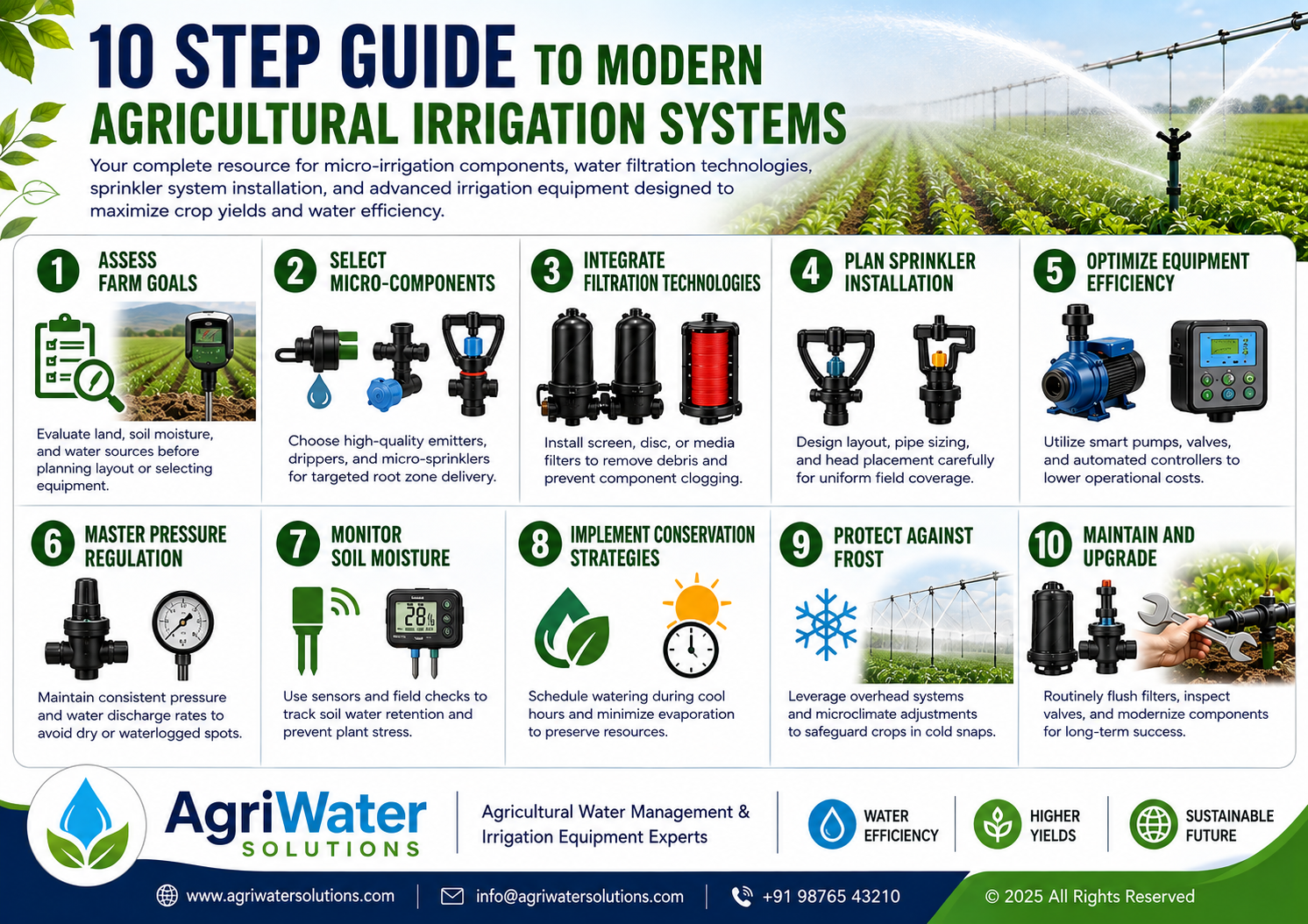


Your complete resource for micro-irrigation components, water filtration technologies, sprinkler system installation, and advanced irrigation equipment – all designed to improve agricultural water management and boost crop yields.
Welcome to the ultimate guide on modern irrigation methods. Whether you are planning a new sprinkler system installation or upgrading your existing irrigation equipment, understanding the core principles of water conservation, pressure regulation, and soil moisture management is crucial. This page covers micro-irrigation components, water filtration technologies, crop irrigation techniques, water discharge rate control, frost protection methods, and microclimate modification strategies – all essential for efficient agricultural water management.
By integrating high-quality micro-irrigation components and advanced water filtration technologies, farmers can achieve superior crop irrigation results while maintaining excellent pressure regulation and optimal water discharge rate. The following 10 steps will guide you through every aspect of designing, installing, and maintaining a system that delivers reliable water conservation and improves soil moisture retention.
Before investing in irrigation equipment or planning a sprinkler system installation, you must evaluate your land, crop type, and water source. Effective agricultural water management starts with understanding the unique requirements of your farm, including soil moisture levels, terrain, and existing micro-irrigation components if any.
Incorporate water filtration technologies early in the planning phase to ensure that the water used for crop irrigation is free from debris. Proper pressure regulation and water discharge rate calculations will help you select the correct pumps and pipes, supporting both water conservation and uniform distribution. Don't forget to consider frost protection and microclimate modification if your region experiences extreme temperatures.
By setting clear goals for agricultural water management, you can choose irrigation equipment that maximizes efficiency while reducing waste. All these factors contribute to better crop irrigation and long-term sustainability of your farming operation.
The heart of any modern irrigation system lies in its micro-irrigation components. These include emitters, drippers, micro-sprinklers, and connectors that deliver water directly to the root zone. Choosing high-quality micro-irrigation components ensures efficient water conservation and precise crop irrigation.
When selecting micro-irrigation components, always pair them with reliable water filtration technologies to prevent clogging. This combination is essential for maintaining consistent water discharge rate and stable pressure regulation across the field. Additionally, the right micro-irrigation components help maintain optimal soil moisture, reducing the need for excessive watering and supporting overall agricultural water management.
Don't overlook the importance of frost protection and microclimate modification when installing micro-irrigation components; some systems can be adapted to provide these benefits, further enhancing your irrigation equipment investment.
Water quality directly impacts the performance of your entire irrigation equipment and micro-irrigation components. Therefore, integrating advanced water filtration technologies is a must for any sprinkler system installation or drip system. Water filtration technologies such as screen filters, disc filters, and media filters remove sediment, algae, and other particles, ensuring that your crop irrigation is clean and uninterrupted.
Proper water filtration technologies also protect pressure regulation valves and maintain a steady water discharge rate. This not only extends the life of your micro-irrigation components but also promotes better soil moisture distribution and effective water conservation. In regions with high frost risk, water filtration technologies can be combined with frost protection measures to prevent ice damage in pipes.
Remember, selecting the right water filtration technologies is a critical component of agricultural water management and helps in achieving uniform crop irrigation while enabling microclimate modification around the plants.
A successful sprinkler system installation requires careful layout planning, pipe sizing, and sprinkler head selection. During sprinkler system installation, you must consider pressure regulation to avoid over- or under-watering, which directly affects water discharge rate and soil moisture levels.
The sprinkler system installation process should incorporate water filtration technologies and high-quality micro-irrigation components where applicable. This integrated approach ensures that your irrigation equipment operates at peak efficiency, contributing to water conservation and improved crop irrigation results. Moreover, a well-executed sprinkler system installation can provide frost protection by creating a thin layer of ice that insulates crops during cold snaps.
Always hire experienced professionals for sprinkler system installation to guarantee proper pressure regulation and accurate water discharge rate. This step is foundational for effective agricultural water management and long-term system reliability.
Your irrigation equipment includes pumps, pipes, valves, controllers, and micro-irrigation components. Selecting energy-efficient irrigation equipment is key to reducing operational costs and supporting water conservation. Regular maintenance of your irrigation equipment ensures that pressure regulation remains stable and water discharge rate stays consistent throughout the season.
Modern irrigation equipment often includes smart controllers that monitor soil moisture and adjust crop irrigation schedules automatically. Pairing such irrigation equipment with water filtration technologies and proper sprinkler system installation maximizes the benefits of agricultural water management. Additionally, advanced irrigation equipment can assist in frost protection and microclimate modification by controlling application timing.
Always evaluate the compatibility of your irrigation equipment with existing micro-irrigation components and water filtration technologies to avoid pressure drops or clogging that could compromise water conservation and crop health.
Pressure regulation is vital for uniform crop irrigation and efficient water discharge rate. Without proper pressure regulation, your micro-irrigation components may deliver uneven water, leading to dry spots or waterlogged areas. This directly impacts soil moisture and undermines water conservation efforts.
In any sprinkler system installation or drip setup, install pressure regulators and check the water discharge rate at various points. This practice, combined with reliable water filtration technologies, ensures that your irrigation equipment functions optimally. Proper pressure regulation also enhances frost protection by allowing precise control during critical temperature drops.
Good agricultural water management requires continuous monitoring of pressure regulation and water discharge rate. These factors, along with microclimate modification techniques, help create an ideal growing environment for your crops.
Understanding soil moisture is fundamental to effective crop irrigation. Using sensors and regular field checks, you can maintain optimal soil moisture levels, reducing unnecessary watering and boosting water conservation. Proper soil moisture management also prevents stress on plants and supports uniform nutrient uptake.
Combine soil moisture data with pressure regulation and water discharge rate adjustments to fine-tune your irrigation equipment. This integrated approach, supported by water filtration technologies and reliable micro-irrigation components, ensures that crop irrigation is both precise and efficient. Additionally, maintaining appropriate soil moisture contributes to frost protection because well-hydrated soil retains heat better.
Remember, agricultural water management is a dynamic process. Continuously update your strategies based on soil moisture readings to achieve the best water conservation results and improve microclimate modification outcomes.
Water conservation is no longer optional—it is a responsibility for every farmer. By using efficient micro-irrigation components and advanced water filtration technologies, you can dramatically reduce water waste. Water conservation also involves scheduling crop irrigation during cooler hours and maintaining proper pressure regulation to avoid runoff.
Effective water conservation practices extend to your sprinkler system installation design, ensuring even coverage with minimal evaporation. Pairing water conservation efforts with regular checks on soil moisture and water discharge rate will maximize the performance of your irrigation equipment. Moreover, water conservation supports frost protection and microclimate modification by maintaining a stable environment around crops.
Adopting water conservation strategies is a key pillar of agricultural water management, enabling you to grow more with less while preserving this precious resource for future generations.
In many regions, frost protection is essential for preventing crop damage during cold nights. Micro-irrigation components such as overhead sprinklers can be used for frost protection by creating a protective ice layer. At the same time, microclimate modification techniques—like using windbreaks or adjusting planting density—help maintain a favorable environment for plant growth.
Integrating frost protection and microclimate modification into your sprinkler system installation can enhance overall crop irrigation outcomes. Ensure that your irrigation equipment supports precise pressure regulation and consistent water discharge rate during frost protection events. Also, clean water from water filtration technologies is critical to prevent nozzle clogging during these operations.
By combining frost protection, microclimate modification, and good agricultural water management, you can safeguard your yields and improve water conservation even under challenging weather conditions.
A well-maintained system of micro-irrigation components, water filtration technologies, and irrigation equipment will provide years of reliable service. Regular maintenance includes flushing filters, checking pressure regulation valves, and verifying water discharge rate at various zones. This proactive approach ensures that crop irrigation remains uniform and soil moisture stays balanced.
Upgrading your sprinkler system installation with modern water filtration technologies and smart irrigation equipment can further enhance water conservation and agricultural water management. Additionally, periodic review of frost protection and microclimate modification strategies will help you adapt to changing climate patterns.
Remember, the key to long-term success lies in continuous improvement of your micro-irrigation components, water filtration technologies, and sprinkler system installation practices. By doing so, you'll achieve optimal crop irrigation, superior water conservation, and robust agricultural water management.
This page has thoroughly discussed the following essential topics for modern agriculture:
micro-irrigation components water filtration technologies sprinkler system installation irrigation equipment agricultural water management water conservation crop irrigation pressure regulation water discharge rate soil moisture frost protection microclimate modification
Each keyword has been strategically integrated throughout the 10-step guide to ensure comprehensive coverage and clarity for readers seeking expert knowledge in irrigation systems.
© 2025 AgriWater Solutions | All Rights Reserved | Agricultural Water Management & Irrigation Equipment Experts
For more information on micro-irrigation components, water filtration technologies, or sprinkler system installation, contact us today.

Buy high-quality PP Irrigation Elbow - 2 Inch, 63mm, outside threaded. Ideal for agricultural irrigation systems. Explore our full range of PP Irrigat...
Read More Share

PP Threaded Fittings, Polypropylene Threaded Fittings, Industrial PP Threaded Fittings, PP Threaded Fittings Manufacturer, Threaded Fittings Exporter ...
Read More Share

The proper nozzle ensures accurate, even delivery of water in the pattern you need. Sprinkler nozzles, also referred to as spray nozzles, are an impor...
Read More Share

The Union Type Plain Valve is ideal for regulating the flow of various fluids and gases impeccably for different industrial processing applications. T...
Read More Share

The PP Threaded End Cap is used while assembling various pipe ending. We’ve used modern technological advanced measures during the fabrication of PP...
Read More Share

Here's a brief description for the product "POONAM LONG BODY COCK 15MM": The POONAM LONG BODY COCK 15MM is a plumbing fitting designed with a longe...
Read More Share
Copyright © 2026 Globle Infotech. All rights reserved.